
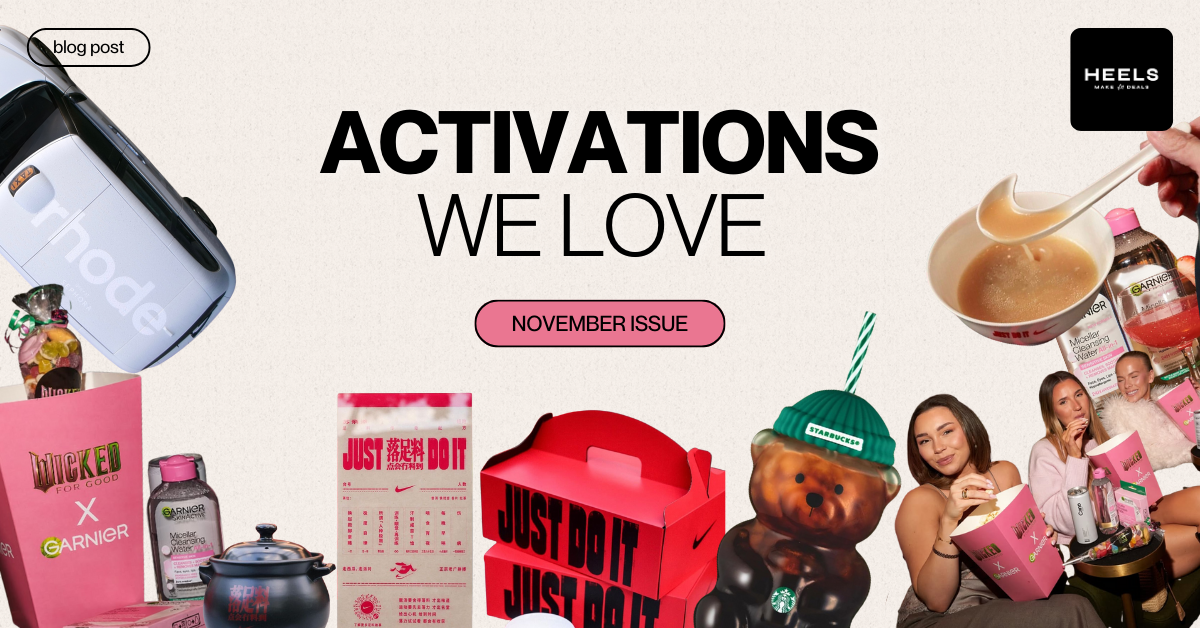
Over the last few months, we’ve seen brands experiment with very different experiential branding trends – from LOEWE’s tomato hot-air balloon moment to collab-heavy launches and perfectly timed cultural tie-ins.
This month added a quieter but important chapter to that story. Instead of chasing scale or spectacle, the most interesting work focused on something smaller and more human: creating little moments people could enjoy, share, and feel part of.
Not playfulness for the sake of being cute, but intentional play grounded in ritual, community, story, or joy. Across categories, brands built experiences that felt personal and low-pressure while still being culturally sharp. These are the four examples that stood out and what modern brands can take from them.


Garnier x Wicked - Beauty Meets Cinema Magic 🍿
Beauty and entertainment have always overlapped, but Garnier’s Wicked For Good screening showed what happens when a brand doesn’t just attach itself to a cultural moment - it builds one.
Garnier hosted an exclusive screening for creators and community members.
And here’s the clever part: they didn’t redesign a single product. They essentially didn’t even need to.
The stars aligned, and the moment did the storytelling. Pink-and-green micellar waters became instant Glinda and Elphaba stand-ins.
Around them were themed snacks, custom drinks, Wicked-branded treats, and photo moments everywhere.
The emphasis was not on a mere product placement but on a full-on organic integration. This is one of the clearest experiential branding trends we are seeing this year: beauty brands stepping into cinema worlds instead of just buying media around them
Why this worked:
✨ Beauty + entertainment = emotional rocket fuel
✨The micellar colours alone carried the concept
✨ People didn’t watch the moment from the outside; they were invited to step into it
What brands can take away:
If your product naturally sits inside a cultural world, lean in. You don’t need a big build-out. What you need is context, imagination, and a story people want to enter.
Heels Make Deals Take 👠
Products become unforgettable when they become characters. Don’t orbit the moment; find a way to place your product inside the scene.
Our September issue broke down how brands nailed cultural timing, in case you missed it.


Nike Soup Shop - Culture First, Product Second 🍲
Yes, Nike opened a soup shop. And surprisingly, it might be one of the smartest cultural moves of the year.
In Guangzhou, Nike launched Cantonese Songyuan, a herbal-soup pop-up created with Olympic sprinter Su Bingtian. Why would a global performance brand serve soup?
Because in Cantonese culture, slow-cooked soups aren’t food; they’re ritual.
Symbols of restoration, resilience, and care.
Meanwhile, in running, recovery is a cornerstone of performance. Nike simply connected two worlds that already spoke the same emotional language. From a distance, it could look like another quirky pop up, but it actually sits at the centre of current experiential branding trends where brands use local rituals to talk about performance.
Why this worked:
🔥 Culture before campaign
🔥 Hyper-local relevance
🔥 A ritual, not a promo
Heels Make Deals Take 👠
This is cultural branding done right: not “we see you” but “we understand you.” When brands honour local rituals, even unexpected ideas feel natural.


Starbucks Bearista - When Cuteness Turns Into Cultural Chaos 🧸
Starbucks released a $29.95 teddy-bear-shaped cold cup… and accidentally triggered a micro-phenomenon.
Within hours:
- lines formed before sunrise
- stock vanished
- resellers inflated prices
- meme accounts erupted
- other brands posted parody bear cups
A single SKU became the internet’s favourite storyline.
Why it worked:
🧩 Cute objects are social currency
🧩 Scarcity creates urgency
🧩 UGC amplifies itself
🧩 Culture hijack = exponential reach
But here’s the real insight
Scarcity creates a desire that can turn into resentment. When too many people walk away empty-handed, the tone shifts. Brands need to know the line between “fun chase” and “brand irritation.”
Heels Make Deals Take 👠
You can engineer hype, but not goodwill. Make sure excitement doesn’t come at the expense of trust.


Rhode x Sephora UK - The Soft-Power Launch Everyone Talked About 💚
For its UK launch, Rhode skipped the typical “big beauty event” formula and instead built something quieter and, as a result, more effective.
Part 1: Daytime
Cream-white branded cabs roam London, offering soft-glow touch-ups and video moments that felt more like stepping into Hailey’s beauty ritual than attending a pop-up.
Part 2: Evening
Then came the evening: a Carbone dinner that translated the Rhode aesthetic into physical space.
Oversized teacups, Rhode-pink everything, curated table styling, and Hailey herself set the tone.
Nothing was loud or poppy; the entire experience leaned on intention rather than spectacle.
Why it worked:
💗 Community-first structure
💗 Cohesive brand world across two moments
💗 Whimsy that never compromised polish
The Twist
Rhode didn’t try to innovate their way into relevance. They simply executed with clarity, and for the customers, clarity is magnetic.
What These Activations Reveal
These examples show that lifestyle brand activations increasingly rely on participation rather than performance, a shift that mirrors how consumers choose to engage with brands today.
Across every category, the same pattern emerged:
1. Play wasn’t decorative; it was an emotional engine.
Ritual shaped Nike’s idea. Rhode leaned into charm. Joy carried the Starbucks moment. And Garnier anchored everything in the story.
Across these examples, playful elements served a purpose. Nike tapped into a cultural ritual to speak about resilience. Rhode used soft, human charm to build emotional closeness. Starbucks leaned into joy and collectability. Garnier created a cinematic moment around a familiar product. In every case, play helped communicate the brand’s deeper truth rather than acting as a superficial add-on.
2. The audience wasn’t a passive viewer; they were a participant.
These brands didn’t ask their audiences to simply watch. What they did was to invite them to do something. Sip a soup with cultural significance. Ride in a branded cab. Join a treasure hunt. Step into a themed screening. When people physically or emotionally take part in a moment, the story expands far beyond the activation itself. That participation is what gives the work longevity.
3. Shareability wasn’t forced; it was the byproduct of meaning.
The visuals spread because they symbolised something.
That bear-shaped cup became a symbol of belonging to a collective moment.
Meanwhile, a Rhode teacup or cab felt like an entry point into a very specific aesthetic world. Garnier’s colour cues connected instantly to a story people already loved. Shareability happens naturally when the imagery carries cultural or emotional relevance. People share what helps them express their identity, not what simply looks pretty. Across all four examples, the strongest experiential branding trends had less to do with scale and more to do with meaning, participation, and emotional clarity.
If you want to create moments like this…
Behind every standout activation this month was the same foundation:
👉 A sharp point of view
👉 A clear brand world
👉 A confident tone
👉 And the ability to move with intention
If your brand isn’t there yet, but you want it to be?
Book your early access spot.
Our 12-week brand program is built for lifestyle founders who want clarity, confidence, and a brand world that creates magic on demand.
Stay iconic 💋



No comments.